
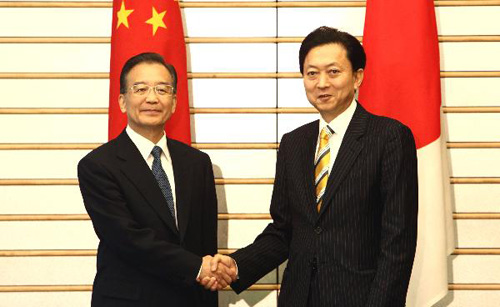
On May 31, 2010, Chinese Premier Wen Jiabao held talks with Japanese Prime Minister Yukio Hatoyama in Tokyo. Both sides have a candid and in-depth exchange of views on China-Japan relations as well as major international and regional issues, and reached a range of important consensus. Both sides agreed to re-establish a hot line between the premiers of the two countries, launch negotiations on implementing principled consensus on the East China Sea issue, speed up the establishment of a maritime communication mechanism between defense departments of the two countries, negotiate and sign an agreement on maritime rescue at an early date, take concrete measures to expand people-to-people and cultural exchanges, and establish a cooperation mechanism on food safety.
During their talks, Wen said that the world economy, though in a complex and difficult situation, is recovering and that the world is undergoing far-reaching changes. Sound China-Japan relations are not only in the fundamental interests of the two countries, but also of vital importance to reinvigorating Asia and promoting world harmony and sustainable development. Both sides should firmly grasp the general direction of China-Japan strategic and reciprocal relations, adhere to the principles and spirits written down in the four political documents between China and Japan, build up strategic mutual trust and ensure that peace, friendship and cooperation remain the mainstream of bilateral relations. Wen emphasized that China adheres to peaceful development and pursues a good-neighborly and friendly policy. "China sees Japan as a strategic partner, not a competitor or a rival. The two countries, as close neighbors and Asian powers, should view each other as partners so as to achieve peaceful coexistence, long-lasting friendship and common development," Wen said.
Wen added that the two sides should strengthen high-level communication, exchange views on major issues in a timely manner, continue to work on implementing principled consensus on the East China Sea issue, strengthen maritime crisis management, and avoid confrontation and conflicts to make the East China Sea "a sea of peace, cooperation and friendship." Both sides should enhance communication and coordination within the frameworks of the six-party talks, the trilateral summit of China, Japan and the ROK and the ASEAN plus 3 to promote regional peace, stability and prosperity.
On economic affairs, Wen said the foundation of economic cooperation between China and Japan is solid. The two economies, which are highly complementary to each other, have withstood the tests of the global financial crisis and shown a rapid growth momentum with broad space for development. Both sides should actively explore new ways and areas of cooperation and cultivate new growth points. The two countries should make best use of the high-level economic dialogue and other mechanisms to enhance macroeconomic policy coordination, and discuss and set the direction of cooperation. They should focus efforts on developing emerging strategic industries and launch a number of major cooperation projects in green economy, energy and environment, and circular economy. China welcomes Japanese businesses to increase investments in China, establish R&D centers in China, promote joint research, development and industry convergence and build more small and medium-sized industrial science and technology parks. Wen said the Chinese government supports competent businesses to invest in Japan and the two governments should create more favorable environment for business cooperation. "Signing the food safety cooperation framework agreement offers the two countries a good chance to promote cooperation in food production and trade," the premier said.
Wen announced China will invite 1,000 youths from Japan to the World Expo in Shanghai, and invite representatives of Japanese rescue and medical teams to revisit Wenchuan of Sichuan Province to see the rebuilding process in the area leveled by a major earthquake in May 2008. China will annually invite 100 people working in media and social sciences from Japan to visit China in the next five years. Wen suggested both countries establish a mechanism of exchange of visits by people working in mass communication and social sciences and hold Film and TV Week and Animation Festival in the other country next year.
Hatoyama said the Japanese government attaches great importance to the strategic mutually beneficial relations with China and is willing to communicate with China on major issues to further improve mutual understanding and trust and properly handle differences and sensitive issues. Japan is ready to work with China to enhance consultations and cooperation and safeguard peace and stability in East China Sea. He thanked for China’s positive efforts in handling the poisoned dumpling case and hoped to further lift the level of bilateral food safety cooperation. Japan also is ready to push forward cooperation with China in energy conservation, environmental protection and green economy and do well in Caofeidian and other demonstration projects. Hatoyama agreed to Wen’s proposal for promoting people-to-people and cultural exchanges between the two countries and pledged to work with the Chinese side to continue to well implement the youth exchange program. Japan will invite 700 people working in media and social sciences from China to visit Japan this and next year, he said, adding that his country has decided to relax visa restrictions on Chinese tourists. Hatoyama said he looks forward to travelling to Shanghai to attend the national pavilion day of Japan in June and believed the Shanghai Expo will greatly boost friendly cooperation between the two countries.
The two leaders also agreed to enhance communication and coordination within the G20, APEC and other frameworks and discussed the situation on the Korean Peninsula.
Following the talks, the two leaders jointly attended the signing ceremony of food safety cooperation framework agreement, as well as other bilateral cooperation documents on energy conservation, environmental protection, personnel training and e-commerce.
Before the talks, Hatoyama hosted a welcome ceremony for Wen.