
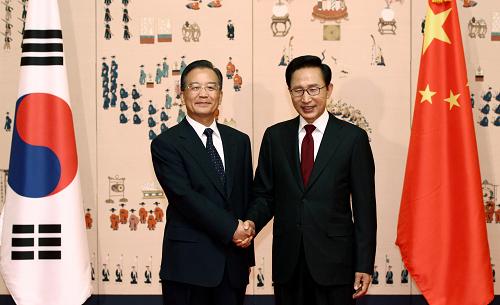
On May 28, 2010, visiting Chinese Premier Wen Jiabao held talks with South Korean President Lee Myung-bak at the Cheong Wa Dae presidential office and residence in Seoul. Both sides exchanged candid, in-depth views on bilateral ties as well as regional and international issues of common concern, agreeing to continue advancing China-ROK strategic cooperative partnership.
Wen said that in recent years, China-ROK relations have made new progress and the two countries have established a strategic cooperative partnership with deepening political trust, fruitful cooperation in all areas and sound communication in major regional and international issues. The two countries have kept close cooperation in the process of tackling the global financial crisis and safeguarded common interests, Wen said. China and South Korea, both important countries in East Asia, have extensive common interests and shoulder common responsibilities as well. China attaches importance to its relations with South Korea, hoping the two countries could work together, take an overall and long-term perspective and enhance communication and cooperation in a bid to benefit the two peoples and promote peace and stability in the region, Wen said.
Wen highlighted the sound development of China-South Korea trade ties, urging the two countries to make joint efforts to overcome difficulties caused by the global financial crisis and promote bilateral cooperation to a new level. China and South Korea should strive to make bilateral trade volume meet the target of 200 billion U.S. dollars by 2012 and 300 billion U.S. dollars by 2015, said Wen. He also suggested that the two countries enhance macroeconomic policy coordination, materialize mid- and long-term trade cooperation guidelines, advance key cooperation areas and projects and explore new trade cooperative fields. "When the joint feasibility study by the governments as well as industrial and academic circles is successfully completed, the two countries can inaugurate negotiations on the China-South Korea FTA in the second half of this year or the first half of next year," said Wen. Both sides should deepen cooperation in areas like high technology and circular economy, facilitate bilateral trade, combat trade protectionism, expand cultural and youth exchanges and build up mutual understanding and friendly feelings between both peoples. They should also step up coordination within the framework of the Group of 20 (G20) and promote reform of the international economic governance system to make it fairer and more rational. "China supports South Korea's efforts for hosting the G20 summit in the second half of this year," said Wen.
President Lee said South Korea and China are both engaged in the development of strategic cooperative partnership, and that cooperation between the two countries has registered rapid progress in various fields with close exchanges at all levels and fruitful cooperation in the economic and trade sector. The two countries, which have worked together to deal with the financial crisis and oppose trade protectionism, are maintaining the momentum of bilateral trade growth and are making important contribution to world's economic recovery, said Lee. He said South Korea is willing to work with China to keep high-level exchange and political dialogue, further improve bilateral trade, quicken FTA construction, and enhance cooperation in such areas as clean energy, environmental protection and the development of green economy. He also urged both sides to take the Shanghai World Expo, the "Visit China Year 2010" and the "Visit South Korea Year 2012" as opportunities to promote people-to-people and cultural exchanges. Lee said South Korea will coordinate with China in multilateral mechanisms like the G20.
Lee briefed Wen on the results of investigation into the sinking of the "Cheonan" warship and considerations on how to deal with the incident. Lee hoped China will play an important role in pushing forward a proper handling of the incident, and in safeguarding peace and stability on the Korean Peninsula.
Wen described the sinking of South Korea's Cheonan warship as unfortunate. He said China understands the sorrows of the bereaved families as well as those of the South Korean people in general. He extended condolences to the victims and sympathy to the families of those killed and to the South Korean people.
The Chinese premier said that as a responsible nation, China takes serious note of the results of an investigation conducted by South Korea and some other countries, as well as the reactions of all parties. China will make a judgment in an "objective and fair manner" and take its position on the basis of facts concerning the incident, Wen said. China is always committed to maintaining peace and stability on the Korean Peninsula and has worked persistently for this end. China rejects and condemns any acts that damage peace and stability on the peninsula, Wen said.
He called on all parties concerned to remain calm and exercise restraint, so as to avert an escalation of the situation. Special efforts should be made to avoid conflicts in order to maintain the hard-won peace and stability on the peninsula, he said.
The Chinese leader also asked all parties to take a long-term perspective, promote the process of the Six-Party talks in a bid to resolve the nuclear issue on the Korean Peninsula for the sake of lasting peace and stability there.
China hopes the South Korean government will properly handle the warship sinking incident, and will keep close communication with South Korea on the issue, said Wen.
Wen and Lee also witnessed the signing of some cooperative documents, including a Memorandum of Understanding on the feasibility study of the China-South Korea FTA by the governments as well as industrial and academic circles.
Prior to the talks, the ROK president held a welcome ceremony for Premier Wen.
On the same day, Wen and Lee met with representatives of a joint research committee of Chinese and South Korean experts and scholars. The two leaders made positive comments on the work of the committee, expressing hope that it will continue to offer advice and suggestions for the development of China-ROK relations.