
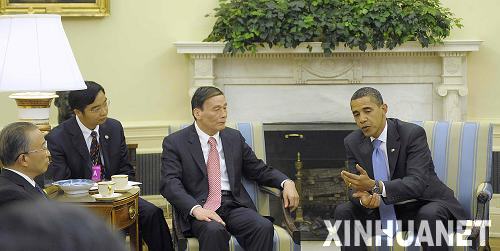
On July 28, 2009, U.S. President Barack Obama met in Washington D.C. with Chinese Vice Premier Wang Qishan and State Councilor Dai Bingguo, also President Hu Jintao's Special Representatives, who were in the U.S. to chair the first round of China-U.S. strategic and economic dialogue.
Chinese Vice Premier Wang Qishan first delivered an oral message from Hu to Obama, in which Hu said the successful holding of the first round of China-U.S. strategic and economic dialogue further enhanced mutual understanding and trust, and expanded bilateral exchange and cooperation. It will exert significant influence on the development of China-U.S. relations, he added. "The China-U.S. relations are at a new historic point and facing new opportunities," Hu said in the message, adding that he would like to make joint efforts with Obama to handle bilateral ties from a strategic and long-term perspective, seize the opportunity to create the future and build a positive, cooperative and comprehensive China-U.S. relationship in the 21st century.
Wang said under the guidance of the two heads of state, both countries had an in-depth exchange of views on the strategic, long-term and overarching issues in bilateral relations, and reached broad consensus. The first round of China-U.S. strategic and economic dialogue was a success, he added. "China is ready to join hands with the U.S. side to help the mechanism of China-U.S. strategic and economic dialogue make more contributions to building the positive, cooperative and comprehensive China-U.S. relationship in the 21st century," he said.
State Councilor Dai Bingguo said the dialogue "yields encouraging outcomes" under the guideline set by the two heads of state. "Practice has proven and will continue to prove that the strategic and economic dialogue, as an important platform for China-U.S. cooperation, will play an important role for the healthy and steady development of the bilateral ties," he said. Dai told Obama that President Hu looked forward to meeting with him in the September G20 summit in Pittsburgh and extended welcome to Obama's first China visit this year.
Dai said China and the United States share common interests and a broad scope of cooperation in the complicated and ever-changing international economic and political situation. "China is ready to work with the U.S. to handle the bilateral ties from a strategic and long-term perspective, further enhance communication, coordination and cooperation in all areas, take the interests and concerns of both sides into account and strive to build the positive, cooperative and comprehensive China-U.S. relationship," the state councilor said.
Obama said both countries made in-depth discussions on a broad range of issues during the dialogue, which helped the two sides effectively address the ongoing financial crisis and achieve balanced economic growth. These will benefit not only the United States and China, but also the whole world, Obama said. The U.S. president also expressed his hope that the two countries could deepen cooperation in various fields, including promoting the reform of the international financial system, maintaining global financial stability, jointly addressing development issues and conducting constructive dialogue on clean energy. Obama also appreciated China's positive role on the Korean Peninsula nuclear issue and Iran nuclear issue.
Calling China a great country and the U.S.-China relations the most important partnership in the 21st century, Obama said he will further push forward U.S.-China relations together with Hu, making it benefit both peoples and the future generations. Obama said he looked forward to visiting China this year.