
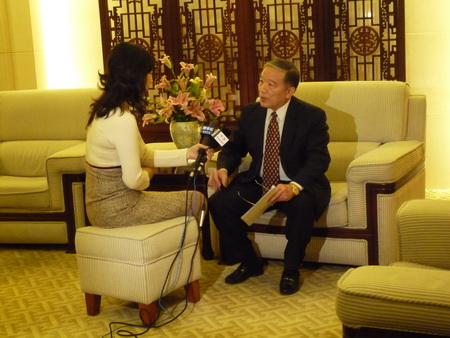
On January 8, 2009, Ambassador Sun Bigan, China's special envoy on the Middle East issue was interviewed by a number of media on the situation in Gaza Strip.
Sun pointed out that Israel had launched massive military operations in Gaza Strip since December 27, 2008 and ground attacks recently. The confrontation so far had caused huge casualties and losses of property, especially the death of innocent civilians. There was still no sign of an end to the fighting. Continued warfare would plunge Gaza into a humanitarian crisis. The Middle East was plagued by turbulence.
He stressed that China was deeply concerned over the ongoing tension and turmoil in the region and the humanitarian crisis in Gaza. It felt sorrowful for the heavy civilian casualties and condemned the actions causing the situation. "As the Chinese special envoy on the Middle East issue, I have been paying close attention to the regional situation and communicated with relevant parties. I believe the current military operations and armed conflicts must stop immediately to prevent further civilian casualties," he said.
He called for efforts in the following three aspects:
First of all, and most pressing, was that there should be an immediate ceasefire and easing of the humanitarian crisis. Israel should immediately end military operations in Gaza, and Hamas should immediately stop launching missiles into Israel. Only when both sides stop, would the situation cease deteriorating. In this way, more lives would be saved and necessary conditions be created for political settlement. The International community and parties concerned should strengthen coordination and build stable channels for the emergency humanitarian assistance into Gaza at an early date in order to ensure the fast, smooth and safe delivery of international assistance of drugs and food to Gaza civilians, the basic treatment of the injured and the supply of necessities to the besieged.
Then, on the basis of ceasefire and easing of the humanitarian crisis, solutions should be sought on realizing endurable ceasefire in Gaza, building the monitoring mechanism and providing humanitarian assistance in a bid to achieve sustained stability. The Security Council was holding an emergency meeting, and the international community had raised certain plans on the international monitoring system of ceasefire and crossings to Gaza. Some countries including Egypt had proposed related initiatives. It's necessary for parties concerned to listen to the appeals of the international community and make early arrangements on border security, opening crossings to Gaza, ending blockades and achieving lasting ceasefire acceptable to all so as to stabilize the situation.
Thirdly, Palestinian-Israeli peace talks should be resumed as soon as possible to seek a fair, just and lasting solution of the Middle East issue. The Gaza conflicts once again proved that military operations could never end Palestinian-Israeli disputes. Military force could only generate more hostility and enmity and would bring no absolute security to either side. While endeavoring to ease the current tension, the international community and parties concerned should consider taking tangible actions to advance Palestinian-Israeli peace talks, establish an independent state of Palestine, realize the peaceful coexistence of Palestine and Israel as "two states" and fundamentally prevent the Gaza conflicts from repeat.
He lastly noted that China had been making efforts to ease situation and humanitarian crisis in Gaza since the outbreak of conflicts. The Chinese leaders exchanged opinions with related parties on the Gaza situation. China also conducted close contacts and consultations with parties involved in the Security Council. It offered US$1 million of emergency humanitarian aid to the Palestinian National Authority and was considering more in the future. China would join hands with the international community to make relentless efforts in order to achieve the goals of ceasefire, stability and resumption of peace talks.