
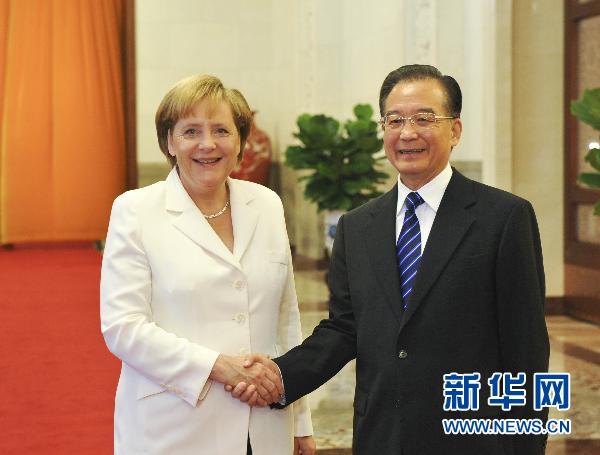
On July 16, 2010, Chinese Premier Wen Jiabao and German Chancellor Angela Merkel held talks at the Great Hall of the People. The two sides reached important consensus on comprehensively promoting the strategic partnership between China and Germany and agreed to issue a joint communiqué drawing up a new blueprint for the development of bilateral relations.
Wen said that China and Germany have important influence in the world, have strong physical economies, and have big manufacturing industries. The two countries are also major trading nations in the world. In the process of responding to the international financial and economic crisis, the two countries strengthened their confidence and solidarity and achieved economic stabilization and growth through painstaking efforts. This strengthened the unity and confidence of the international community and made important contributions to world economic recovery. Mutual understanding and trust between the two countries were deepened. The bilateral relations withstood severe tests and became even closer. The strategic nature of bilateral ties was further highlighted. Wen stressed that China and Germany are two great nations shouldering important missions. “We not only need to strengthen our confidence to tide over the crisis, but also need to go hand in hand to achieve common development. This is also in line with the fundamental interest of the people of our two countries and the people of the world. I believe that through unremitting efforts of both sides, Sino-German relations will reach a higher level.”
Merkel said that Germany and China have much in common. Facing the international financial crisis, the two countries worked in close coordination and cooperation and Sino-German cooperation became a model for active cooperation between developed and developing countries under the new situation. Germany appreciates China for depending on its own efforts and taking measures such as boosting domestic demands to tackle the international financial crisis. The healthy and stable development of China’s economy benefits Germany and the world. Although turning for the better, the world economy was not stable. Germany and China should further strengthen cooperation and make greater contributions to the strong recovery and sustainable growth of the world economy. The two sides issued a joint statement for the comprehensive promotion of bilateral strategic partnership, which fully reflected the strong will of the two countries. Germany is willing to work with China to advance bilateral relations more firmly and broadly.
The two prime ministers agreed that economic growth and sustainable development are the first and foremost tasks of the international community, which also offer an important opportunity for both parties to deepen bilateral ties. The two sides need to strengthen dialogue and cooperation in a wide range of areas including politics, economy and culture.
First, to maintain close high-level exchanges and dialogue at various levels, continuously enhance mutual understanding and trust, properly handle differences and enable bilateral relations to stand on a reliable political basis. The two sides will establish a government consultation mechanism and upgrade the strategic dialogue level.
Second, to take advantage of the opportunity presented by China in the process of expanding domestic demands, accelerating industrial restructuring and promoting regional development to upgrade cooperation in all fields and geographic regions to higher levels and promote the strong and sustainable development of economic and trade relations between the two countries. The two sides jointly oppose trade protectionism. The Chinese government will continue to take measures to further open markets and optimize trade and investment environment. The Chinese side welcomes the expansion of German exports of large-scale complete sets of mechanical and electrical equipment to China, the transfer of its investment to high-end manufacturing and its participation in developing the western region of China. Germany welcomes more Chinese enterprises to invest in Germany and supports cooperation between small and medium enterprises (SMEs).
Third, to establish a partnership in energy and environment and increase cooperation in the fields of energy conservation, environmental protection, new energy and green economy. To expand high-tech trade, establish joint research centers and labs, and carry out demo cooperation in the field of electric vehicles.
Fourth, to strengthen cultural exchanges between the two countries and the exchanges between local regions and successfully run the "Chinese Culture Year" activities to be held in Germany in 2012. China supports the Global School Partnerships initiative of Germany and proposes that the primary, secondary and vocational schools of the two countries form 200 pairs of partnership and regularize the youth exchanges between the two countries.
Fifth, to maintain close communication and coordination at the United Nations, the World Trade Organization and the Group of 20, strengthen cooperation on major issues such as the international financial system reform, climate change, the Millennium Development Goals, energy security and sovereign credit ratings, effectively deal with global challenges, work together to drive the establishment of a fair and reasonable new international political and economic order, and promote world harmony and sustainable development.
Wen said that China attaches great importance to developing China-EU comprehensive strategic partnership, appreciates Germany for expressing support for EU’s recognition of China’s full market economy status, and welcomes Germany to play a more active and effective role in promoting the development of China-EU relations. China supports the European Union and the International Monetary Fund to take measures to deal with the sovereign debt crises in some European countries and supports the stability of the euro. China is willing to strengthen communication and coordination with the EU to overcome difficulties and achieve common development.
Merkel said that the EU attaches strategic importance to strengthening the cooperation with China. Germany is strongly committed to promoting EU-China relations. The issue of EU’s recognition of China's full market economy status should be resolved fairly and as early as possible. Germany is willing to work actively in this direction. Germany thanks the Chinese side for supporting the EU integration and helping the EU overcome the difficulties. Germany expects China to remain confident in the euro.
After the talks, the two prime ministers witnessed the signing of a series of cooperation documents covering wide-ranging areas including economy, technology, finance, ecological and environmental protection, electrical science, automobile and culture, and jointly met with members of the second Sino-German dialogue forum and journalists.
Before the talks, Premier Wen Jiabao held a welcome ceremony for German Chancellor Merkel at the Great Hall of the People. Vice Chairman of the Central Committee of China KMT Revolutionary Committee Wan Exiang, Foreign Minister Yang Jiechi, Director of the National Development and Reform Commission Zhang Ping, Minister of Science and Technology Wan Gang, Minister of Commerce Chen Deming, Chinese Ambassador to Germany Wu Hongbo and other top Chinese officials attended the ceremony.