
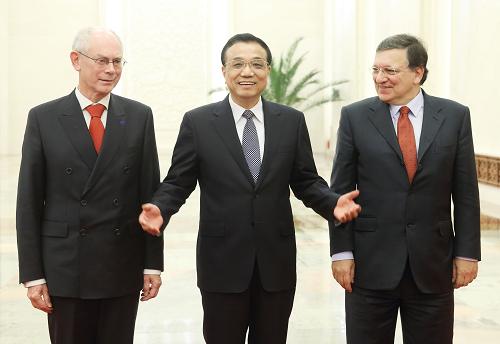
On the afternoon of November 21, 2013, Premier Li Keqiang of the State Council, President Herman Van Rompuy of the European Council and President José Manuel Barroso of the European Commission jointly chaired the 16th China-EU Summit at the Great Hall of the People.
"China places great importance to China-EU relations. President Xi Jinping had a meeting with you yesterday; today we're chairing the China-EU Summit, which coincides with a historical moment in our relationship, the 10th anniversary of China-EU comprehensive strategic partnership. EU is an important pole in a multi-polar world as well as an important partner for China in our modernization drive. Enhancing our cooperation not only complies with the common interests of China and EU, but also will send out a positive message of peace, development and cooperation to the world," said Li Keqiang.
Li Keqiang said that both China and EU are at a critical stage of development. At a result, it becomes more necessary and urgent for the two sides to deepen bilateral relations. China firmly supports the European integration process and is happy to say a strong, prosperous and united European Union. We wish to work together with the EU side to navigate China-EU relations toward the right direction. Based on the principles of mutual trust and win-win cooperation, the two sides are able to handle the problems and differences encountered in the course of cooperation in a proper manner and push for new progress for China-EU comprehensive strategic partnership.
Herman Van Rompuy and José Manuel Barroso said that since the establishment of EU-China comprehensive partnership a decade ago, bilateral relations have become more mature, have witnessed great development and have contributed to global peace, stability and development. In the coming decade, EU-China relations will enjoy a promising prospect. The EU side supports China to deepen the reform in an all-round manner and is willing to strengthen communication with China, trust each other and support each other. The EU side is willing to work with China to push the negotiations on EU-China investment agreement forward, expand mutually-beneficial cooperation, and resolve frictions and differences through dialogues and negotiations. The EU side is willing to work with China to oppose trade and investment protectionism, strengthen coordination and collaboration on regional and international affairs and boost the long-term, healthy development of EU-China relations.
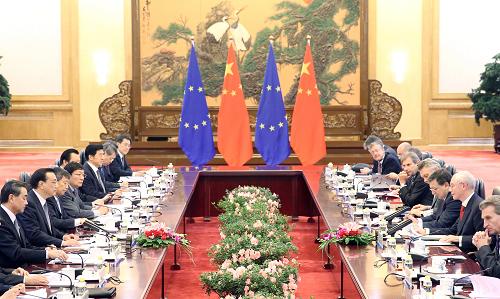
The leaders have reached the following important consensus on enhancing the comprehensive cooperation between China and EU:
First, to bring China-EU economic and trade cooperation to new levels with the negotiations on the investment agreement as the driver. To launch and advance the negotiation process and strive to bring bilateral trade volume to $1 trillion by 2020. To adhere to market opening, strengthen financial cooperation, properly handle differences through equal dialogues and friendly negotiations, and take effective measures to expand bilateral high-tech trade.
Second, to create new highlights for China-EU cooperation. To engage in scientific and technological innovation cooperation, drive the development of emerging industries such as new energy, new materials, new generation information technology, biology, aeronautics and aerospace, and advance the cooperation in the new type of people-centric urbanization.
Third, to push the cooperation in transportation and infrastructure toward a more interconnected, compatible, intelligent and advanced direction. To boost the connectivity between the Asian and European continents and build an interconnected China-Europe logistics network.
Fourth, to give full play to the role of the High-Level People-to-People Dialogue (HPPD), expand exchange in education, culture, youth, public policies and other related areas, accelerate the negotiations on the agreements facilitating people exchange and create better conditions for the exchanges of businesses and people.
Fifth, to enhance cooperation in regional and international affairs. To increase exchanges in climate change, cybersecurity, arms control and anti-proliferation and other global issues, enhance coordination within multi-lateral frameworks, such as the United Nations, the Group of Twenty and Asia-Europe Meeting, push international economic and political order towards a more equitable, reasonable and effective direction, and safeguard world peace and stability.
After the meeting, Li Keqiang, Herman Van Rompuy and José Manuel Barroso jointly attended the signing ceremonies of a series of cooperative documents covering agriculture, energy, and intellectual property. The two sides will also issue the 2020 Strategic Plan for China-EU Cooperation.