
The 11th Five Year Plan period is a period vital to the peaceful development of China. During the five years, China made great achievements on the diplomatic front through pioneering efforts against all odds.
During the 12th Five Year Plan, the overall international situation is expected to remain peaceful and stable, a generally favorable external environment will not change for China, and the country will still be in a period of important strategic opportunities in which it can make great achievements.
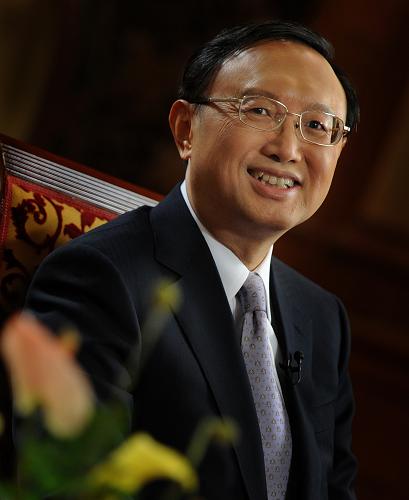
Foreign Minister Yang Jiechi recently gave an interview to national media for the Program of "Interview with Provincial Governors and Ministers" at the Diaoyutai State Guesthouse. He introduced to journalists the achievements China had made in diplomacy in the past five years, analyzed the international situation facing China now and in the coming five years and shared his views on a series of issues such as China-US relations, neighborhood diplomacy and public diplomacy.
Q: China made remarkable achievements in diplomacy during the 11th Five Year Plan, can you share with us the main features and highlights as well as the valuable experience gained in the diplomatic efforts?
A: The five years of the implementation of the 11th Five Year Plan is a period vital to the peaceful development of China. During the five years, China stood up to difficulties, blazed new trails and made major achievements on the diplomatic front. Under the leadership of the Central Committee of the CPC and the State Council, China successfully held major events, appropriately managed difficulties and accomplished important tasks in its diplomatic work, making fresh progress in all-dimensional diplomacy.
Five events in this period have far-reaching impact: the success of the Beijing Summit of the Forum on China-Africa Cooperation, the Beijing Olympic Games and the Shanghai World Expo, effective response to the international financial crisis and constructive participation in the international effort against climate change. These five events show what China has, what it can offer and what it strives for: China has a good foundation for economic and social development, and an advantage of pooling resources for big undertakings and is willing and ready to shoulder more international responsibilities within its capability. China gives confidence and hope to the global economic recovery and growth and is offering more and more public goods to the world. China strives for equality of developing countries in international affairs and a more just and equitable international order. The five events quickly put China in the spotlight on the world stage and demonstrated that China is an important force for world peace and common development.
Specifically speaking, China has focused its efforts on the following seven aspects. First, by taking an active part in summit diplomacy, China played the role of a responsible big country. Chinese leaders attended major multilateral and bilateral events such as the G20 summits, which greatly promoted the reform of the international system and bilateral friendship and cooperation. Second, China engaged in all-dimensional diplomacy, promoted its all-round cooperation with major countries, neighboring countries, developing countries and international organizations, actively advanced its diplomatic agenda across the board, and further improved China's diplomatic layout. Third, China stressed the importance of economic diplomacy, built on good political ties to enhance economic cooperation, facilitated the implementation of the strategies of "bringing in" and "going global", and stepped up cooperation in various fields such as energy and resources. Fourth, China relied on security diplomacy as a guarantee to appropriately handle major contingencies and resolutely combat and counter separatist activities for "Taiwan independence", "Tibet independence", or "East Turkistan", and effectively upheld its national stability, sovereignty and security. Fifth, China pursued "diplomacy for the people", appropriately coped with serious emergencies such as evacuation of Chinese nationals from conflict zones, rescue of hostages and labor disputes, further improved its consular protection mechanism and effectively protected its legitimate rights and interests overseas. Sixth, China made use of public and people-to-people diplomacy as a platform, seized the important opportunities in hosting the Beijing Olympic Games and Shanghai World Expo and enhanced its soft power. Seventh, China viewed theoretical innovation as a driving force, continued to enrich and develop a diplomatic theoretical system with Chinese characteristics, and greatly enhanced its capability and level of conducting diplomacy in a scientific way.
Over the five years, as we made continued progress on the diplomatic front under complex circumstances, we have felt keenly the importance of adhering to the Party's central and unified leadership in diplomatic work, to the continuous effort of enriching and developing the diplomatic theoretical system with Chinese characteristics, to the central tasks of the Party and the state in diplomacy, to the principle of putting national sovereignty, security and development interests first, to the endeavor of enriching and improving all-dimensional diplomacy and to the purposes and principles of putting people first and diplomacy for the people.
Q: China-US relationship is an important link in China's major country diplomacy. How do you view the current China-US relationship and its development trend?
A: In recent years, thanks to the joint efforts of China and the United States, the growth of bilateral relations has been on the whole on an even keel. The two countries agreed to build a positive, cooperative and comprehensive China-US relationship for the 21st century and reached important agreement on steadily building a partnership to address common challenges. The two sides have made steady progress in mutually beneficial cooperation in various fields, and maintained effective communication and coordination on global issues and regional hotspot issues. But the development of the bilateral relationship has not always been plain sailing. We urge the US side to honor the principles and spirit of the three Sino-US joint communiqués and the China-US Joint Statement, respect China's sovereignty and territorial integrity and refrain from interfering in China's internal affairs.
China and the United States may not see eye to eye on some issues. The two sides should enhance mutual trust through candid dialogue and appropriately handle these issues. The China-US relationship should be one of win-win cooperation rather than a zero-sum game. The interests of China and the United States have been intertwined in a wider range of areas as a result of globalization. The two sides need to build a cooperative partnership of mutual benefit in various fields. I believe efforts in the following three areas are essential to advancing China-US relations under the new circumstances.
First, we should understand each other and enhance mutual trust. China needs to understand the United States and the United States also needs to understand China. China is committed to peaceful development and the win-win strategy of opening-up. To enhance mutual trust, it is important to learn to respect each other's core concerns, reject the outdated and stereotyped mindset and work in the same direction.
Second, we should treat each other with mutual respect and as equals. We should respect the different realities of China and the United States in terms of social system, cultural tradition and development stage. We should not seek to change the other side, or impose one's own model on the other. The frictions and differences should be appropriately managed through dialogue on an equal footing.
Third, we should expand cooperation and pursue win-win progress. By making our common interests a bigger pie, we can enable people of our two countries to get more benefit from expanded exchanges and our two economies will also stand to gain from stronger cooperation. Protectionism, trade wars and "currency wars" would only harm the interests of both sides and bring more trouble to the bilateral relationship.
Q: Relations with neighboring countries figure importantly in China's overall foreign relations. What's your assessment of China's current relations with its neighbors?
A: I believe Asia is at an important stage of historic development and changes. Countries in Asia have successfully countered the financial crisis and realized fairly fast economic growth. Regional cooperation enjoys vigorous development, people-to-people and cultural exchanges continue to expand and the international standing of the region is rising notably. There are broad prospects for their further development. At the same time, for historical and present-day reasons, Asia is also confronted with some problems and challenges, which, from time to time, affect regional stability. It therefore remains a long and arduous task to attain enduring peace and common prosperity.
China is always committed to developing friendship and partnerships with neighboring countries. And China has made comprehensive progress in its friendly ties and cooperation with its neighbors. On the political front, we have close high-level contact and stronger mutual trust with other Asian countries. This year, we have exchanged high-level visits with almost all countries in Asia. On the economic front, we are committed to mutual benefit and win-win progress and our converging interests have been deepening. China's trade with other Asian nations has grown by over 20% a year on average. For many years in a row, China has been Asia's largest import market and the biggest trading partner of Japan, the ROK and India. Asia now hosts more overseas enterprises of China than any other part of the world. On the security front, we advocate a new security concept with mutual trust, mutual benefit, equality and coordination at the core. We work for negotiated solutions to regional hot-spot issues, such as the Korean nuclear issue. Our cooperation has continued to strengthen in counter-terrorism, non-proliferation and other fields. On the cultural front, we actively promote cooperation in education and culture. Over 100,000 students from other Asian nations study in China and the figure has been quite stable. We have established over 100 Confucius institutes and classes in Asia. On regional cooperation, we have taken an active part in 10+1, 10+3, China-Japan-ROK, the East Asia Summit, the Asia-Pacific Economic Cooperation (APEC) and the Shanghai Cooperation Organization and other cooperation mechanisms, and we have played an important role in the development and improvement of those mechanisms. We also welcome a constructive role of relevant countries in regional cooperation and their contribution to an open, inclusive, cooperative and win-win regional cooperation architecture.
China will continue to work with other countries for a peaceful and stable Asia featuring equality, mutual trust and win-win cooperation.
Q: You have attached great importance to the work of public diplomacy since you took office as the Foreign Minister. How do you see the role of public diplomacy? What has been done?
A: Public diplomacy is a special form of diplomacy, different from traditional diplomacy. In public diplomacy, the government has a leading role to play, all social sectors are involved, and such means as communication and exchanges are used to inform the public abroad of a country's national conditions, policies and ideas and to inform the public at home of the country's diplomatic principles, polices and measures. It aims to gain the understanding, recognition and support from the public home and abroad. It is very important for us to enhance public diplomacy to help the international community view China in a right perspective and enable the Chinese public to better understand and support China's diplomatic endeavors.
In recent years, we have increased input in public diplomacy. We have established and improved the institutions and mechanisms for public diplomacy. For example, we launched the Foreign Ministry's Open Day Events and we held the Lanting Forum. The Foreign Ministry and our diplomatic and consular missions abroad have organized a great variety of activities surrounding such major events as the Beijing Olympic Games, the Shanghai World Expo and the Guangzhou Asian Games, generating a strong interest in China globally. I believe that with our joint efforts, even greater progress will be made in public diplomacy.
Q: What are China's major plans in the diplomatic field during the 12th Five Year Plan period? What are the priorities?
A: During the 12th Five Year Plan period, the international situation is expected to maintain overall peace and stability. A generally favorable external environment for China will not change, and the country will still be in an important period of strategic opportunities during which there is a great deal it can achieve. On the diplomatic front, China is faced with both precious historic opportunities and many foreseeable and unforeseeable difficulties and challenges. We have a glorious mission with great responsibilities.
We should earnestly study and act on the spirit of the 5th Plenary Session of the 17th Party Central Committee, continue to seize and make good use of the important period of strategic opportunities, adhere to the main purpose of serving national development with diplomacy, firmly uphold our sovereignty, security and development interests, and shape a more favorable external environment. We will continue to promote relations with major countries, and develop a framework for relations with major countries featuring overall stability, relative balance, and win-win cooperation. We will continue to deepen friendly ties with neighboring countries to consolidate the favorable neighboring environment featuring peace, stability and common development. We will strengthen the traditional friendship with developing countries to reinforce their fundamental position in China's overall diplomacy. We will take an active part in multilateral cooperation and play an important, constructive role in the reform of the international system. We will make solid progress in economic diplomacy to serve the accelerated transformation of economic development pattern. We will actively engage in security diplomacy to safeguard our sovereignty and security interests. We will also vigorously promote public diplomacy and people-to-people and cultural diplomacy and develop a theoretical system of diplomacy with Chinese characteristics. I am convinced that under the leadership of the Party Central Committee and the State Council and with the strong support of our people, our diplomatic service will make even greater contribution to the efforts of building a moderately prosperous society in an all-round way.