
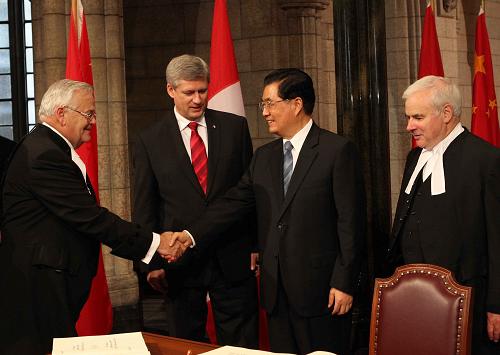
On June 24, 2010, Chinese President Hu Jintao held talks with Canadian Prime Minister Stephen Harper in Ottawa. Both sides held talks on bilateral ties as well as international and regional issues of common concern in a candid and in-depth manner and reached important consensus.
Hu pointed out that since the two countries established diplomatic ties 40 years ago, bilateral relations have been developing vigorously and the exchanges and cooperation in all areas have achieved remarkable outcome. The Chinese president said under the current international situation, the two countries, as influential countries in the world, share broad common interests and huge potential for cooperation in such areas as promoting their own economic growths and the world economic recovery, and addressing major global challenges concerning the future and destiny of mankind.
Hu emphasized that China attaches great importance to developing strategic partnership with Canada and is ready to work with it to take the opportunity of the 40th anniversary of the establishment of diplomatic ties and push forward bilateral ties at a new starting point.
Hu put forward five proposals for further advancing China-Canada relations. First, increasing contact at high and other levels. China welcomes Canadian Governor-General Michaelle Jean to attend the Canadian National Pavilion Day of the Shanghai World Expo next month and welcomes more visits to China by the Canadian government, parliament and political party leaders. Hu urged both sides to give further play to the role of China-Canada Strategic Working Group and other bilateral consultation mechanisms and enhance bilateral dialogue and exchanges in all areas. Second, expanding practical cooperation. China deems Canada an important cooperation partner and is ready to tap potential and jointly push bilateral mutually beneficial cooperation to a new level. Hu proposed that the two countries expand trade and investment scale and strive to raise the volume of two-way trade to 60 billion U.S. dollars by 2015. They should also encourage reciprocal investment between the businesses of the two countries. Hu urged both sides to deepen cooperation on energy and resources, establish long-term and stable partnership and advance mutually beneficial cooperation in the fields of mineral resources development, oil sand, natural gas, nuclear energy and new energy to facilitate and support expanded cooperation between the businesses of the two countries. Both sides should complement each other with their respective advantages, expand cooperation in the areas of science, technology, agriculture, environmental protection, health, transportation, aviation, infrastructure and financial services and create new highlights for cooperation. Both sides should cooperate in opposing protectionism and properly handle trade frictions through dialogues and consultations by proceeding from the overall development of China-Canada economic and trade relations. Third, stepping up cultural and people-to-people exchanges. Hu urged both sides to promote exchanges on culture, education, sports and media, especially between the youth to build up mutual understanding and friendship between both peoples. China will establish a China Cultural Center in Canada and invite 100 local Canadian educational officials and headmasters of primary and middle schools to visit China this year and 100 Canadian middle school students to attend a summer camp in China next year. China welcomes relevant departments of the two countries to officially sign the agreement to designate Canada as a destination of overseas travel by Chinese citizens and welcomes more Canadian citizens to visit the Shanghai World Expo. Fourth, enhancing cooperation in global and regional affairs. Hu said China is willing to step up coordination and cooperation with Canada on the reform of the United Nations, climate change, nuclear non-proliferation, nuclear disarmament, international peace-keeping and global public health. The two countries should work together to build a harmonious world of lasting peace and common prosperity. Fifth, respecting each other's core interests and major concerns. China appreciates Canada for reaffirming adherence to the one-China policy on many occasions and respecting China’s sovereignty and territorial integrity. He expressed hope that Canada will continue to understand and support China’s position and properly handle sensitive issues, which is crucial to the long-term healthy and stable development of China-Canada relations.
Harper extended warm welcome for Hu’s visit. He said President Hu’s state visit to Canada is of great significance as it not only coincides with the 40th anniversary of the establishment of China-Canada diplomatic ties, but also with the G20 Toronto Summit. Over the past four decades, China's international status has been improving continuously and Canada-China cooperation in all areas has made great progress. Harper said that Canada-China relations have become one of the most important bilateral relations in the world and bilateral relations have great potential for further growth. He said he was delighted with the signing of the tourist destination country agreement between the two countries and new progress made in agricultural cooperation. He noted Canada is ready to work with China to further advance the strategic partnership between the two countries. He hoped the two countries would maintain high-level contact, further expand practical cooperation and exchanges in various fields, especially in the fields of politics, energy, resources, finance, culture, education and media and push forward the work of China-Canada Strategic Working Group. Canada attaches importance to China’s important status in the world economy and is ready to enhance strategic cooperation with China in the economic and trade sector and jointly oppose protectionism. He hoped that both sides will strengthen cooperation in public health, climate change and other global issues as well as within the multilateral frameworks including the Group of 20.
Harper said Canada firmly and unequivocally adheres to the one-China policy and regards respect of each other’s state sovereignty and territorial integrity as a foundation of handling bilateral relations.
Both sides also exchanged views on the upcoming G20 Toronto Summit as well as international and regional issues of common concern.
After the talks, the two leaders witnessed the signing of cooperation documents between the two countries, which included the agreement to designate Canada as a destination of overseas travel by Chinese citizens. They also jointly met the press.
Wang Qishan, Ling Jihua, Wang Huning, Dai Bingguo and other officials attended the above activities.