
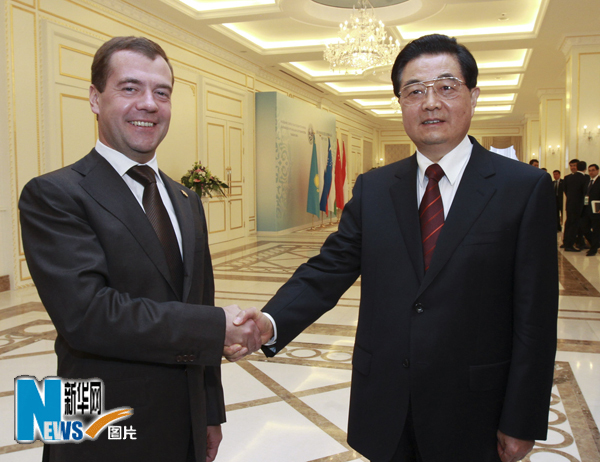
On June 10, 2010, Chinese President Hu Jintao met with his Russian counterpart Dmitry Medvedev in Tashkent.
Hu said there had been all-round progress in China-Russia relations in the first half of this year. Noting this was the two presidents' third meeting so far this year, Hu said they had reached new consensus on strengthening strategic coordination and deepening pragmatic cooperation. Hu said bilateral relations would see a number of major events in the second half of this year. He said that, first of all, the two countries should make good arrangements for high-level contacts in this period, including Medvedev's visit to China and the regular meeting of prime ministers of the two countries to maintain the strong growth momentum of bilateral ties. Secondly, Hu said the two sides should work to advance cooperation in such areas as trade, economy, energy and at local levels to lift the level of practical cooperation and achieve more results. Thirdly, he said the two countries should continue to promote cultural and people-to-people exchanges by holding "Chinese Language Year" activities in Russia to consolidate the social foundation for developing ties. Fourthly, the two countries should strengthen strategic communications on the reform of the international system and in major international and regional issues, in a bid to effectively safeguard both countries' interests in terms of peace and development, Hu said.
The Chinese president also pointed out three aspects of work to focus on for the SCO in the future. He said that, firstly, solidarity and mutual trust should be continuously deepened to lay solid political foundations for the sound and healthy development of the organization and to upgrade the level of regional cooperation. Secondly, SCO member countries should stick to security and pragmatic cooperation as priorities to achieve more concrete results and to benefit the people in all member states, Hu said. Thirdly, he said the SCO, upon strengthening its own capability, should carry out external exchanges and cooperation to boost its international status and influence. The Chinese leader said the SCO would mark its 10th anniversary next year, and that celebrations should be arranged as early as possible. He hoped it would be a chance to add new impetus to the development of the organization. China was willing to work with Russia to continue to strengthen coordination to boost the sound and healthy development of the SCO, Hu said.
He was also confident that the China-Russia strategic partnership of coordination would achieve new development and reach new level with the joint efforts of both sides.
Medvedev said that he was glad to meet with President Hu on the sidelines of the annual summit of the Shanghai Cooperation Organization (SCO) and thanked him for attending the 65th anniversary celebration of victory in Russia's Great Patriotic War. Medvedev also hailed the development of his country's strategic partnership of coordination with China. Russia would join hands with China to further deepen bilateral ties, expand trade cooperation, boost cultural and people-to-people exchanges and cooperation, Medvedev said. Russia was also ready to work with China in organizing "Chinese Language Year" activities in Russia, promoting contacts and coordination in regional and international issues, and maintaining coordination under the framework of the SCO to safeguard the peace and stability of the region as well as of the world at large, Medvedev said. The Russian leader said he was looking forward to a visit to China this autumn during which he would continue to exchange views with Chinese leaders on boosting cooperation and other issues of common concern.
Ling Jihua, Wang Huning, Dai Bingguo and other officials attended the meeting.