
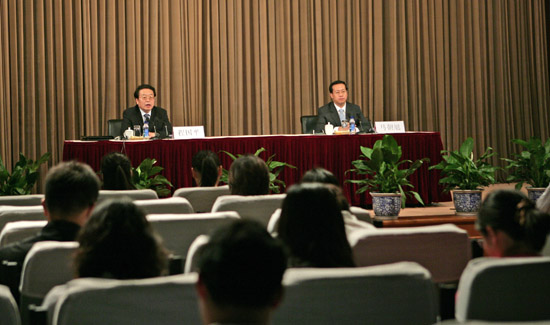
On June 4, 2010, the Ministry of Foreign Affairs (MFA) held a briefing for Chinese and foreign media. Assistant Foreign Minister Cheng Guoping introduced the background, major activities and significance of President Hu Jintao's presence at the Shanghai Cooperation Organization (SCO) summit in Tashkent and state visit to Uzbekistan and Kazakhstan.
Cheng said that Chinese President Hu Jintao, at the invitation of President of Uzbekistan Islam Karimov and President of Kazakhstan Nursultan Nazarbayev, will pay a state visit to Uzbekistan, attend the 10th Meeting of the Council of Heads of States of SCO in Tashkent, capital of Uzbekistan and pay a state visit to Kazakhstan from June 9 to 12, 2010. It is a major diplomatic activity of Chinese national leaders this year.
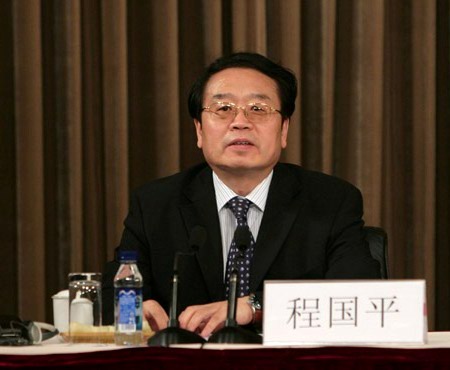
He noted that the international situation is experiencing complex changes and undergoing profound adjustments. The world economy recovers slowly, regional security situation remains serious, the development of SCO faces new opportunities and challenges and member states have a stronger will and desire of making joint efforts to boost development. Both Uzbekistan and Kazakhstan are friendly close neighbors and important partners of China. With a profound traditional friendship, China and the two countries enjoy close pragmatic cooperation and personnel exchanges. It is an unswerving policy of the Chinese government to consolidate and advance the political mutual trust and friendly cooperation with Uzbekistan and Kazakhstan, which serves the common interest of people of all the three countries. President Hu's visit to Central Asia is of special significance to promoting the SCO's sustainable, healthy and stable development, comprehensively stepping up China's relations with Uzbekistan and Kazakhstan, deepening China's mutually beneficial cooperation with the SCO member states and observer states in various fields, maintaining security and stability in the region and the world at large and building a harmonious region with lasting peace and common prosperity.
I. President Hu's state visit to Uzbekistan

Cheng said that China-Uzbekistan relations have maintained a sound momentum of healthy and stable development since the two countries established diplomatic ties 18 years ago. When President Hu paid the formal visit to Uzbekistan in June 2004, the two heads of state jointly announced the establishment of China-Uzbekistan friendly and cooperative partnership. When President Karimov visited China in May 2005, the two heads of state signed the Treaty of Friendly and Cooperative Partnership between China and Uzbekistan. These mutual visits led the bilateral relations to a new stage of rapid and comprehensive development. In recent years, China and Uzbekistan have maintained close high-level exchanges and deep political mutual trust. President Hu met with President Karimov twice in 2009. Vice Premier Li Keqiang paid a formal visit to Uzbekistan and held talks with First Deputy Prime Minister Rustam Azimov in June. Leaders of both countries exchanged in-depth views and reached wide consensuses on the development of bilateral relations and pragmatic cooperation. The bilateral pragmatic cooperation in the areas of economy and trade, energy, transport, communication and infrastructure construction continues expanding and has achieved satisfactory results. Even against the background of international financial crisis, China-Uzbekistan trade volume increased positively. In 2009, the bilateral trade volume reached US$1.91 billion, up 18.9% over 2008. The natural gas pipeline linking the two countries realized one-way ventilation at the end of last year. The two sides cooperate actively in the field of security and jointly crack down on the "three forces" including the "East Turkistan" and cross-nation crimes such as drug smuggling. They enjoy sound cooperation in the UN, the SCO and other multilateral frameworks and close coordination in both regional and international affairs and make due contributions to promoting peace and stability of their own and in the region as well.
Cheng indicated that it is the second state visit President Hu paid to Uzbekistan after 2004. During the visit, President Hu will hold talks and meetings with President Karimov and other Uzbek leaders. The two sides will exchange opinions on the current state and prospect of bilateral relations and other international and regional issues of common concern. They will sign a number of cooperation documents covering economy and trade. With the joint efforts of both sides, President Hu's visit will achieve full success and inject greater vigor into the development of China-Uzbekistan friendly and cooperative partnership.
II. President Hu's presence at the SCO summit in Tashkent
Cheng pointed out that President Hu will attend the 10th Meeting of the Council of Heads of States of SCO in Tashkent on June 11. Since the Yekaterinburg summit in 2009, the SCO has maintained a sound momentum of development and played a greater role in protecting the common interest of member states, safeguarding regional security and stability, tackling international financial crisis and boosting common development despite the complicated and fluctuating international and regional situation. The SCO member states have strengthened solidarity, mutual trust and strategic cooperation, extended stronger support to each other on the major core issues concerning independence, sovereignty and security and helped each other to cope with natural disasters and terrorist attacks at critical moment, which fully demonstrates the strength of collective efforts; they have conducted in-depth security cooperation, advanced cooperation on anti-terrorism, drug control and fighting against organized crimes side by side and carried out effective security and safety cooperation for such major international events as the Shanghai World Expo and the 65th anniversary celebrations on the victory in the Great Patriotic War. The establishment of emergency response mechanism enables the SCO to strengthen the response and joint operation capacity; member states have reinforced confidence and tackled the international financial crisis calmly, deepened regional economic cooperation through jointly formulating and implementing counter-crisis measures and providing large amount of preferential credit, enabled the region to recover from the crisis early and made contributions to the complete recovery of world economy with their own development. Over the past year, members states have steadily pushed forward their cooperation on economy and trade, finance, transport, communication and agriculture, conducted fruitful cooperation in the fields of science and technology, culture, education and emergency relief, carried out external exchanges more actively, stepped up cooperation with the observer states, operated the partnership mechanism soundly, engaged in in-depth cooperation with the UN and increased the international status and influence of the SCO.
Cheng said that the international situation is experiencing complex and profound changes with clear increase of uncertain and unstable factors. The basis of world economic recovery remains weak and global challenges such as climate change, food security and energy sources are interwoven with each other. The activities of "three forces" in the region grow increasingly rampant. Under such circumstances, member states have realized keenly that to effectively cope with emerging threats and challenges and safeguard their fundamental interest they must unswervingly promote the SCO's development, further gather consensus, tap potential and deepen cooperation. As an important meeting held against such background, the Tashkent summit will focus on the themes of strengthening solidarity and cooperation, maintaining stability and seeking common development. The purpose and task of the summit is to continue to comprehensively implement the Treaty on Long-Term Good-Neighborliness, Friendship and Cooperation between the Member States of the Shanghai Cooperation Organization, increase political mutual trust, deepen security, economic and cultural cooperation and enable the SCO to play a bigger role of consolidating security and stability and promoting harmonious development in the region.
He indicated that the summit, as a relatively large event, will be attended by leaders of the observer states and guest states of the host country as well as the UN, the Commonwealth of Independent States, the Eurasian Economic Community and the Collective Security Treaty Organization in addition to the heads of member states. The number of participants shows rising cohesion and influence of the SCO. Conventionally, a series of activities, including the small-scale talks of heads of member states, large-scale talks of national leaders, document signing ceremony and joint press conferences will be held during the summit. Participating leaders will also hold talks and meetings extensively to exchange views on the SCO's development, bilateral relations and other international and regional issues of common concern. They will comprehensively review the progress the organization achieved during last year, make in-depth analysis on the international and regional situation and the challenges and opportunities faced by the organization, define the organization's direction and tasks of future development and make deployment and planning on how to deepen the political, security, economic and culture cooperation and expanding the organization's external exchanges. National leaders will mainly share views on the issues of fighting the "three forces", maintaining security and stability and enhancing pragmatic cooperation.
Cheng noted that the summit will achieve fruitful results. It will issue the Declaration of the 10th Meeting of the Council of Heads of States of SCO and the Press Release. Furthermore, currently the member states are discussing such important documents as the SCO Regulation on Accepting New Members and the SCO Rules of Procedure which are expected to be submitted to the summit for approval. The Declaration will elaborate the common position of member states on the international and regional situation and other major issues. The Rules of Procedure is a key document drafted by the member states with the purpose of increasing efficiency and improving internal system building on the basis of reviewing 9 years of development of the SCO, marking the SCO's system building enters into the stage of complete maturity. It should be noted especially that the Regulation on Accepting New Members is an important result of a dozen of consultations among the member states over 2 years. The approval of the Regulation on Accepting New Members marks the first step of member states of forging the legal basis for new member admission. It will become a cornerstone of the legal framework on the admission of new members. Experts of member states will continue to carefully discuss the possible legal and organizational issues caused by membership expansion, add more details to related legal provisions and improve the legal foundation of membership expansion. At present, member states are making final preparations for the summit. With the joint efforts of all sides, the Tashkent summit will achieve full success and become another grand event in the history of the SCO.
III. President Hu's state visit to Kazakhstan
Cheng said that China-Kazakhstan relations have developed healthily and stably since the two countries established diplomatic ties. China and Kazakhstan built the strategic partnership in 2005. China-Kazakhstan strategic partnership has experienced comprehensive, deep and rapid development in recent years. The two countries enjoy frequent high-level exchanges and ever deepening political mutual trust. They signed a number of important bilateral documents, including the Treaty of Good-Neighborly Friendship and Cooperation, the Joint Statement on the Establishment of Strategic Partnership and the 21st Century Cooperation Strategy and set up China-Kazakhstan cooperation committee to guild and coordinate the bilateral cooperation in various fields including economy and trade, energy, transport, port, security, science and technology, culture and education. In the process of completely implementing the bilateral agreement on jointly fighting the "three forces", they conducted effective cooperation to crack down on the "three forces" including the "East Turkistan". The two countries enjoy fruitful partnership in the multilateral frameworks of the UN, the SCO and the Conference on Interaction and Confidence-Building Measures in Asia (CICA), collaborate with each other in regional and international affairs and play a positive role of safeguarding peace, stability and development in the region and the world at large.
He noted that President Hu's upcoming state visit to Kazakhstan, after his working visit to the country in December last year, is a major event of bilateral relations this year. Both sides attach great importance to the visit and have made careful preparations. During the visit, President Hu will hold talks and meetings with President Nazarbayev and other leaders of Kazakhstan. Leaders of both countries will exchange opinions on further developing China-Kazakhstan relations, deepening bilateral pragmatic cooperation and other international and regional issues of common concern. The two sides will sign bilateral cooperation documents in the field of economy and trade. With the joint efforts of both sides, President Hu's visit will help maintain the sound momentum of high-level exchanges, deepen the mutual political trust, boost the development of pragmatic cooperation between China and Kazakhstan and lift China-Kazakhstan strategic partnership to a new level.
Cheng also answered questions of journalists. Ma Zhaoxu, Director-General of the Information Department of the MFA hosted the briefing which was attended by more than 70 Chinese and foreign journalists.