
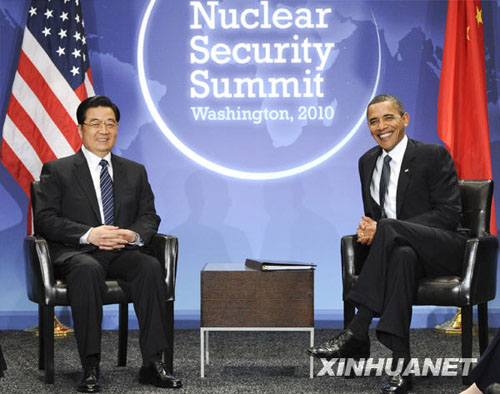
On April 12, 2010, Chinese President Hu Jintao met with his U.S. counterpart, Barack Obama, in Washington. Both sides exchanged views on bilateral relations, as well as major international and regional issues of common concern, and reached important consensus.
Hu said that a good China-U.S. relationship serves the common interests of the two countries and contributes to world peace, stability and prosperity. China is ready to work with the United States to enhance dialogue, build up mutual trust and expand cooperation to push forward China-U.S. relations.
In the meeting, Hu put forward a five-point proposal for developing China-U.S. relations in the next phase.
First, the two sides should persistently stick to the right direction of bilateral ties, and take concrete moves to establish a partnership to jointly deal with common challenges, said Hu. Both sides should firmly grasp this right direction of bilateral ties.
Second, China and the United States should respect each other's core interests and major concerns. This is key to the healthy and stable development of bilateral ties, he said. The Taiwan and Tibet issues concern China's sovereignty and territorial integrity and its core interests. China hopes the United States would keep its promises and handle these issues with caution, so that further setbacks in China-U.S. ties could be averted.
Third, the two sides should keep exchanges at different levels, said Hu, adding he is willing to keep close contact with Obama. China and the United States should jointly push for positive results at the second round of China-U.S. strategic and economic dialogue and an early launch of the cultural exchange mechanism, said Hu.
Fourth, the two countries should deepen practical cooperation. China would like to strengthen exchanges and cooperation with the United States in economy and trade, counter-terrorism, energy, environment, and law enforcement. China is also willing to explore cooperation in civil aviation, high-speed train and infrastructure, said Hu. China expects outstanding U.S. exhibitions at the upcoming Shanghai Expo and welcomes U.S. citizens to the event.
Fifth, China and the United States should strengthen communication and coordination on major international and regional hotspot issues as well as global issues. The two sides should continue to strengthen macroeconomic policy coordination and their cooperation in the framework of the Group of 20 to push for further recovery of the world economy. China is also ready to enhance communication and coordination with the U.S. on such issues as climate change, global nuclear security, reform of the UN Security Council, as well as the nuclear issues of Iran and the Korean Peninsula and South Asia's stability, to jointly safeguard and promote world peace, stability and prosperity.
President Hu pointed out that the advancement of Sino-U.S. economic and trade ties, an important part of the two countries' relations, would benefit not only China, but also the United States, as well as the world's economic development. "At present, the world economy is at a critical moment for further revival, but still facing many uncertainties. Both China and the United States are facing difficult tasks of promoting economic growth, creating jobs, and changing economic development modes. We should strengthen cooperation and maintain international economic and financial stability under such circumstances," he added.
On bilateral economic and trade ties, Hu pointed out RMB appreciation would neither balance Sino-U.S. trade nor solve the unemployment problem in the United States. The Chinese leader said his country does not intend to pursue a trade surplus over the United States. China would like to take additional measures to increase imports from the United States, Hu said, urging the United States to loosen its export control over high-tech products so that exports to China could be increased. He expressed the hope that trade frictions between the two countries can be solved through negotiations so that Sino-U.S. economic and trade cooperation can be maintained. China would firmly stick to the path of reforming its currency exchange rate formation mechanism based on its own economic and social development needs. Hu said detailed measures for reform should be considered in the context of the world's economic situation, its development and changes, as well as China's economic conditions, and in particular will not be launched under external pressure.
Obama expressed warm welcome for Hu to come to Washington for the nuclear security summit. The U.S. president said the whole world is paying close attention to the development of U.S.-China relations. The strengthening of cooperation and the building of partnership between the two countries are not only in the interests of both countries, but also of the world, he said, adding that the two countries have already established powerful links, thanks to joint efforts. Washington is willing to work with China to build even stronger ties through bilateral and multilateral dialogues and cooperation in such frameworks as the Strategic and Economic Dialogue and the Group of 20 (G20) summits, Obama said. The United States also wishes to strengthen cooperation with China to seek solutions to global issues such as climate change, counter-terrorism and nuclear non-proliferation, he said. Obama also pledged personal efforts in developing U.S.-China relations in the years to come to make the ties even stronger.
Obama reiterated Washington's willingness to stick to the one-China policy, respect China's sovereignty and territorial integrity and its core interests, and address sensitive issues with due care.
The United States believes that a prosperous China will not only benefit China, but also is good for the United States and the entire world, Obama said. Both countries should cooperate in the G20 framework to re-balance the world economy, he added. Obama said that his country respects China's sovereignty concerning the Renminbi (RMB) exchange rate issue. He hoped the two sides could find a solution through dialogue and cooperation.
On the Iranian nuclear issue, Obama stated his country's position. The U.S. wished to resolve the Iranian nuclear issue through diplomacy, and expected cooperation with China in this regard. Hu said that China and the United States have the same overall goal on the Iranian nuclear issue. China stands ready to maintain consultation and coordination with the United States and other parties within the 5-plus-1 mechanism, in the United Nations and through other channels, he added.
Ling Jihua, Wang Huning, Dai Bingguo and other officials attended the meeting.