
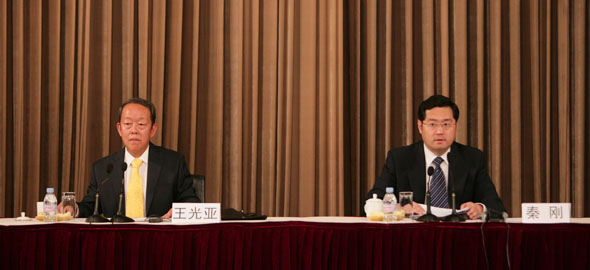
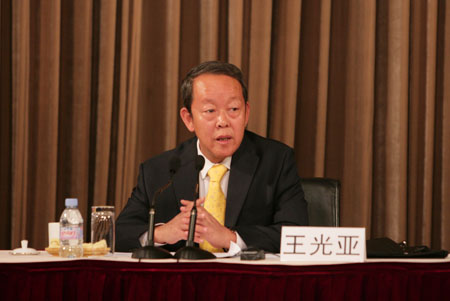
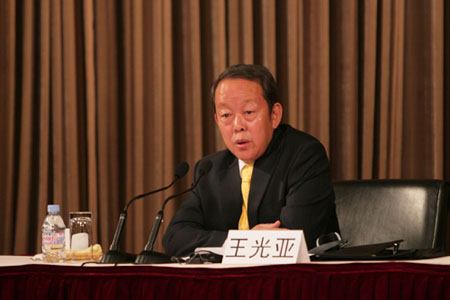
On October 9, 2009, Vice Foreign Minister Wang Guangya held a briefing for Chinese and foreign media, introducing Russian Prime Minister Vladimir Putin's upcoming visit to China, the 14th regular meeting between Chinese and Russian prime ministers and the 8th prime ministers' meeting of the Shanghai Cooperation Organization (SCO) member states. Deputy Director-General Qin Gang of the Information Department hosted the briefing.
I. Putin's visit to China and the 14th regular meeting between Chinese and Russian prime ministers
Wang said that Prime Minister Putin, at the invitation of Premier Wen Jiabao, will pay an official visit to China and attend the 14th regular meeting between Chinese and Russian prime ministers from October 12 to 14, 2009. This regular meeting has great significance to advancing the China-Russia strategic cooperative partnership, deepening the bilateral pragmatic cooperation, coping with the international financial crisis, boosting the economic and social progress of China and Russia and promoting peace and stability in this region and the world at large. Russian Deputy Prime Minister Alexander Zhukov and Deputy Prime Minister Igor Sechin will visit China prior to the Chinese and Russian prime ministers' regular meeting to make preparations. Sechin will hold the 5th meeting of bilateral energy negotiations with Chinese vice Premier Wang Qishan in Beijing. Zhukov will hold the 13th conference of the joint commission for the regular prime ministers' meetings with Wang Qishan in Beijing and the 10th meeting of the committee on China-Russia cultural cooperation with State Councilor Liu Yandong in Dalian.
Wang stressed that this year marks the 60th anniversary of China-Russia diplomatic ties and the "Year of Russian Language" in China. Standing at a new historical starting point, China-Russia strategic cooperative partnership has maintained a sound momentum of all-round and rapid development, which is mainly reflected in the following areas:
First, solid legal basis. In July 2001, the heads of state of both countries signed the China-Russia Good-Neighborly Friendship and Cooperation Treaty which established the principles and direction of development of China-Russia relations as well as the peaceful thought of passing China-Russia friendship from generation to generation. In November 2008, they approved the second-stage Implementation Outline of China-Russia Good-Neighborly Friendship and Cooperation Treaty (2009-2012) which defined the specific direction, programs and objectives of bilateral cooperation in five major areas involving politics, economy, culture, national defense, disaster relief, justice and law enforcement and international affairs from 2009 to 2012. They passed the Planning Framework of China-Russia Investment Cooperation in June and the Planning Framework of Regional Cooperation between Northeast China and Russian Far East and Eastern Siberia in September this year, which established the priorities and key programs of mutual investment and local cooperation between the two countries.
Second, comprehensive cooperation mechanism. China and Russia have set up the prime ministers' regular meeting mechanism, the parliamentary cooperation mechanism and the strategic security consultation mechanism. Their government agencies have basically established the inter-ministerial cooperation mechanisms covering all the fields of bilateral relations. The bilateral cooperation has entered a systematized and standardized track.
Third, increasing strategic mutual trust. The two countries share firm support on major issues related to each other's national sovereignty and territorial integrity. Through close high-level contacts, their leaders have exchanged in-depth opinions on the bilateral relations and major international issues in a timely manner. President Hu Jintao paid a state visit to Russia in June and the two heads of state also met each other on a number of multilateral occasions, including the G20 summit in London, the SCO summit in Yekaterinburg, the "BRIC" summit, series of UN summits and the G20 summit in Pittsburg.
Fourth, rich and substantive strategic connotation. China-Russia strategic cooperative partnership is a new type of state relations based on good-neighborly friendship, equality and mutual trust, mutually beneficial cooperation and common development. Following the principle of "non-alignment, non-confrontation and non-targeting at any third party", the two countries have vigorously strengthened political, economic, cultural, scientific, technological and military cooperation and successfully resolved the remaining border issues left over by history. China and Russia are both major powers in the world and permanent members of the Security Council. The stable development of their strategic cooperative partnership over the years has made an irreplaceable contribution to promoting world peace, stability and development, maintaining global strategic balance, pushing forward the multi-polarization process and establishing a more just and rational new international political and economic order. The bilateral strategic cooperative partnership has become the model for the development of state relations.
Fifth, fruitful down-to-earth cooperation. The bilateral cooperation in trade, investment, energy, science, technology and environmental protection and at local levels has achieved long-term progress. At present, China is the 3rd largest trade partner of Russia, while Russia is the 11th biggest trade partner of China. The bilateral trade enjoys ever improving structure, expanding areas and rapid growth of total volume. Despite the negative impact of the international financial crisis on bilateral trade, China and Russia are confident of rallying and pushing the bilateral trade back on track.
Sixth, all-round progress of humanities cooperation. The bilateral cooperation and exchanges in the educational, cultural, health, sports, tourism and media fields have been deepened gradually. Following the Year of China in Russia and the Year of Russia in China activities, both sides have launched the language year programs. The 2009 "Year of Russian Language" in China has stimulated the enthusiasm and interest of Chinese young students of learning Russian language and culture and set off a new upsurge in cultural exchanges between the two countries. They are going to launch the "Year of Chinese Language" next year in Russia.
Wang noted that Prime Minister Putin during the visit will hold talks with Premier Wen Jiabao and meet with President Hu Jintao and Chairman Wu Bangguo respectively. Both sides will sign relevant cooperation documents. The Chinese and Russian prime ministers will jointly meet the media to introduce the outcome of their regular meeting and also attend and address the celebration on the 60th anniversary of China-Russia diplomatic ties & closing ceremony of the "Year of Russian Language" in China. The Chinese Ministry of Commerce and the Russian Ministry of Economic Development will convene the 4th China-Russia business summit forum which the Chinese and Russian prime ministers will attend and address.
II. The 8th prime ministers' meeting of the SCO member states
Wang said that the 8th prime ministers' meeting of the SCO member states will kick off in Beijing on October 14. Premier Wen will chair the meeting which is the most important event of the SCO in the second half of this year and the second one of its kind hosted by China since 2003.
He indicated that the SCO has withstood tests of fluctuating international situation and maintained a sound momentum of development in recent years. Its member states have strengthened solidarity and collaboration than ever before and firmly support each other on issues linked with their core interests, such as sovereignty, security and development. Their security cooperation has been deepened. The first meeting between the ministers of interior affairs and public security and meeting of heads of anti-drug authorities have been held and their security and safety cooperation for Shanghai World Expo has been launched comprehensively following the successful security and safety cooperation during Beijing Olympic Games. The SCO member states have become major trade partners to each other as their economic cooperation goes on. Their cooperation in the fields of transportation, energy, communication and agriculture has moved forward stably. The humanities cooperation is in the ascendant. Member states have achieved remarkable fruits of scientific, technological, cultural and educational cooperation and successfully held the joint exercise of disaster relief. As external exchanges grow dynamically, the observer nations were once again invited to the economic and trade ministerial meeting of SCO, which has boosted the bilateral cooperation substantively. The official launch of dialogue partner mechanism has further expanded the international arena for the opening-up and cooperation of SCO.
The SCO summit in Yekaterinburg was held successfully in June this year, which consolidated the common position of member states of pushing for the settlement of global and regional issues and established the general thought of furthering political mutual trust, deepening pragmatic cooperation and promoting the organization's healthy and stable development. Under the complicated international political and economic situation, the summit played a critical role of cementing consensus, boosting confidence and indicating future direction. The member states unanimously decided to make the implementation of Yekaterinburg summit consensus the core task of next stage.
He noted that the international and regional situations are still undergoing profound changes. The comprehensive recovery of world economy will experience twists and turns, the impact of international financial crisis on the member states has yet not subsided and many social problems like unemployment and poverty wait to be solved. In this region, the "three evil forces" have reemerged, drug trafficking and cross-border organized crimes remain rampant, the Afghan situation continues with turbulence and major public health and security incidents occur frequently, which poses real threats to regional peace and stability. The internal and external environment for SCO's development is not optimistic. Faced with new problems, new threats and new challenges, member states have deeply realized that only by strengthening solidarity and helping each other can they defuse crisis to the maximum extent and ensure development more effectively. They have stronger aspiration than ever before to reinforce cooperation. The major topic of the meeting is to discuss how to deepen the SCO's cooperation in the economic and humanities sectors against the background of increasing global and regional challenges like the international financial crisis so as to ensure its healthy and stable development. The meeting of prime ministers is of important and far-reaching significance to implementing the SCO Member States Treaty on Long-Term Good-Neighborliness, Friendship and Cooperation and the consensus reached at the Yekaterinburg summit, further boosting the development of the organization and promoting the building of a harmonious region with lasting peace and common prosperity.
He added that as a routine practice the meeting has invited prime ministers of SCO member states, prime ministers or leaders at corresponding level of observer states, i.e. Mongolia, Pakistan, Iran and India and host country's guest state Afghanistan. So far, the prime ministers of SCO member states have all confirmed their attendance. Major activities during the meeting include small-scale talks of member states' prime ministers, document signing ceremony, joint press conference and large-scale talks of all participants. Premier Wen will hold bilateral meetings with leaders of relevant countries. The SCO Forum of Industry and Commerce will also be held.
As to the procedure and expected outcome of the meeting, Wang said that Premier Wen and leaders of other countries will comprehensively review the progress of SCO's cooperation in the economic and humanities fields since last prime ministers' meeting in Astana, make in-depth analysis of current international and regional situations and plan the priorities of the organization's future work in line with the consensus reached at the Yekaterinburg summit. Following the meeting, prime ministers will issue a joint communiqué, approve several resolutions on the organization's internal affairs like finance and witness the signing of customs cooperation protocol. Currently, member states are busy with discussing the documents to be signed and making final preparations for the prime ministers' meeting. Participants of the SCO Forum of Industry and Commerce to be attended by senior government officials and business delegates of member states will discuss how to tackle the financial crisis, bring into play the role of SCO Business Council and Interbank Association and facilitate small and medium-sized enterprises' participation in regional economic cooperation. With the concerted efforts of all parties concerned, the meeting will achieve full success and inject vigor into the SCO's development and regional stability and prosperity.
Later Wang Guangya answered questions of the reporters.
Concerning China-Russia energy cooperation, Wang said that it is one of the priority areas of bilateral partnership. In April this year, the two sides signed the intergovernmental agreement on oil cooperation and a package of cooperation documents, including China-Russia crude oil pipeline construction and operation contract, crude oil purchase and sale contract and credit agreement, also went into effect officially, which marks a historic breakthrough and a new stage of China-Russia energy cooperation. In April and May this year, the Russian section and Chinese section of crude oil pipeline formally started construction, with various projects being implemented steadily following the schedule reached by both sides. China and Russia will continue to carefully fulfill relevant agreements and try their best to complete the construction of crude oil pipeline and put it into operation before the end of 2010 and start oil transmission from 2011. Natural gas cooperation is another important component of China-Russia energy cooperation. Wang Qishan and Sechin, as representatives of China-Russia energy negotiations, signed the MOU on Natural Gas Cooperation in June this year, authorizing businesses of both countries to negotiate the bilateral natural gas pipeline project. In addition, nuclear energy cooperation is also a priority of bilateral cooperation. Energy cooperation is a key part of China-Russia strategic cooperative partnership and bilateral trade and economic cooperation as well as a realistic choice of mutual benefit for both countries since they enjoy such unique advantages as geographical proximity, convenient transportation and strong market complementarities. China is willing to make joint efforts with Russia to push forward the bilateral energy cooperation.
With regard to SCO member states' security cooperation, Wang noted that international terrorism is a major challenge faced by all countries in the world as well as a serious threat to peace and security of this region. To jointly crack down on the "three evil forces" including international terrorism always remains an important task of SCO. During this meeting, parties concerned will further strengthen the determination of jointly fighting against terrorism. Their security and safety cooperation for Shanghai World Expo has kicked off following the success during Beijing Olympic Games. To enhance communication and cooperation with the international community, including the SCO member states, is indispensable for ensuring security of Shanghai World Expo.
On the Afghan issue, Wang pointed out that Afghanistan is an important neighboring country in this region. The SCO member states, including China, always pay close attention to the development of Afghan situation and have all made efforts in their own way for Afghanistan's peaceful reconstruction. It is hoped that Afghanistan will realize peace and stability as soon as possible with the help of the international community. The issue of Afghan situation will be discussed during the meeting, especially at bilateral meetings.
As to China's US$10 billion of credit to the SCO, Wang explained that shortage of fund constitutes a major difficulty and challenge in the economic sector to the SCO. China attaches great importance to this problem and has assisted within its own capacity other member states in infrastructure construction. President Hu announced to offer US$10 billion of credit support to SCO member states in June this year, which member states all highly appreciate. The Chinese side then studied how to use the credit and is open to close consultations with other member states in this regard. Priority of the credit will continue to be given to implementing the network projects within the SCO framework such as transportation, energy and communication which involve wide participation and benefit multiple parties as well as to some projects of other member states aiming at improving people's livelihood and economic development. Related details will be further clarified at the upcoming prime ministers' meeting.
 |
 |
 |
 |