
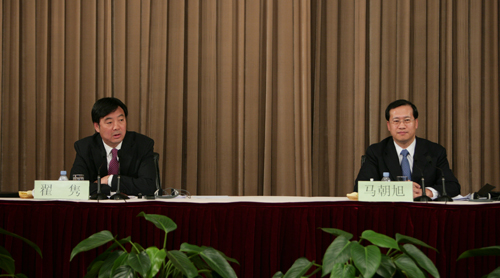
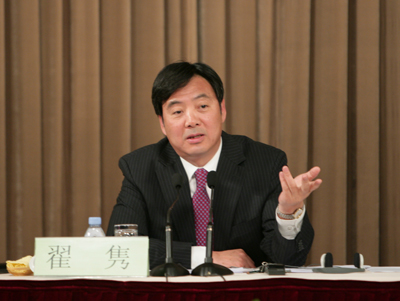
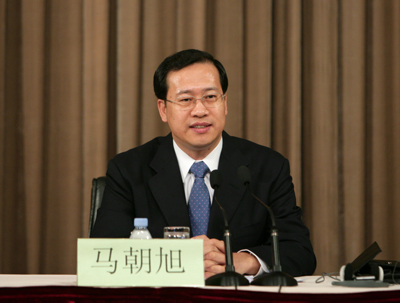
The foreign ministry held a briefing for Chinese and overseas journalists on February 6, 2009. Assistant Foreign Minister Zhai Jun introduced President Hu Jintao’s upcoming visits to Saudi Arabia, Mali, Senegal, Tanzania and Mauritius from February 10 to 17. Director-General Ma Zhaoxu of the Information Department hosted the briefing.

I. Background and objectives of the visits
Zhai noted that the sprawling international financial crisis has transferred from the developed countries to the emerging economies and developing ones, from the financial sector to the real economy. The developing countries including China, Saudi Arabia and those in Africa face increasing challenges. China support efforts to minimize the impact of crisis on the developing countries and expects to strengthen cooperation and coordinate efforts with the international community including the rest of developing nations to overcome difficulties.
Since China and Saudi Arabia established diplomatic ties in 1990, the bilateral relations have developed steadily. In particular, the bilateral relations have enjoyed comprehensive and rapid progress in recent years and the two countries have built a strategic friendship. Saudi Arabia is China’s biggest trade partner in western Asia and Africa over the years. China’s cooperation with the Gulf Cooperation Council (GCC) also strides forward vigorously.
China’s relations with Africa have developed rapidly in recent years, especially since the Beijing Summit of the Forum on China-Africa Cooperation (FOCAC). With the great support and close collaboration of both China and Africa, the follow-up activities of the Summit are being implemented stably. China and Africa enjoy ever closer political relations and deeper pragmatic cooperation. Both sides extend greater support to each other in international affairs. China’s eight policy measures on the pragmatic cooperation with Africa have achieved positive outcomes. 2009 is the last year of implementing the outcomes of the Summit. The fourth FOCAC ministerial level meeting will be held in the fourth quarter this year, marking that China-Africa relations stand at a critical development stage.
He stressed that it will be President Hu’s first foreign visit in 2009 as well as second visit to African countries since the FOCAC Beijing Summit in 2006. The visits aim at consolidating China-Saudi Arabia strategic friendship, pushing forward China’s collective cooperation with the GCC, promoting the implementation of the final stage of Beijing Summit outcomes, deepening the new type of China-Africa strategic partnership, strengthening China’s friendly cooperation with the four African countries and boosting common development.
II. About visits arrangement
i. Visit to Saudi Arabia
Zhai said that President Hu will visit Saudi Arabia from February 10 to 12. He will hold talks with King Abdullah bin Abdul-Aziz to exchange in-depth opinions on further consolidating and reinforcing the bilateral strategic friendship and the international and regional issues of common concern. President Hu will also meet with GCC Secretary General Abdul Rahman Al-Attiyah to exchange views on strengthening the collective cooperation between China and the GCC. He will also visit the cement production line project of Saudi Arabia Riyadh Cement Company built by Chinese company.
ii. Visit to Mali
Zhai noted that Mali is one of the first Sub-Saharan African countries establishing diplomatic ties with China. China and Mali enjoy long-term friendly relations. President Hu will visit the country from February 12 to 13. He will hold talks with President Amadou Toumany Toure and meet with President of Mali National Assembly Dioncounda Traore to exchange opinions on the bilateral ties and China-Africa relations. He will also attend the launch ceremony on the construction of the third bridge of Bamako financed by China, visit members of the Chinese medical team in Mali and participate in the inauguration ceremony of the anti-malaria center financed by China.
iii. Visit to Senegal
Zhai said that Senegal is a country resuming diplomatic ties with China recently. The bilateral relations have developed stably since the two countries resumed diplomatic ties in October 2005. President Hu will visit Senegal from February 13 to 14. He will hold talks with President Abdoulaye Wade and meet with Senate Speaker Pape Diop and Speaker of the National Assembly Hon Mamadou Seck to exchange views on the bilateral relations and implementation of the outcomes of the FOCAC Beijing Summit as well as other international and regional issues of common interest. President Hu will also visit the China-financed project.
iv. Visit to Tanzania
Zhai said that Tanzania is a traditional friend of China. This year marks the 45th anniversary of the bilateral diplomatic ties. President Hu will visit the country from February 14 to 16. He will hold talks with President Jakaya Mrisho Kikwete and meet with Zanzibar President Amani Abeid Karume to exchange opinions on the bilateral ties, the implementation of FOCAC Beijing Summit outcomes in Tanzania and the international financial crisis. He will also attend the completion ceremony of the Tanzanian national stadium financed by China, pay regard to the cemetery of Chinese experts assisting Tanzania and deliver a speech to the welcome meeting hosted by Tanzania.
v. Visit to Mauritius
Zhai noted that the bilateral relations between China and Mauritius have grown steadily since the establishment of diplomatic ties in 1972. The two countries enjoy fruitful trade and economic cooperation. President Hu will visit the country from February 16 to 17. He will hold talks with Prime Minister Ramgoolam and meet with President Anerood Jugnauth to exchange views on the bilateral relations, how to cope with the financial crisis and other international and regional issues of common concern. President Hu will also visit the Chinese Cultural Center.
He added that the leaders and governments of the five countries all attach great importance to the visits of President Hu and have made careful preparations. He expressed confidence that the visits will achieve big success with the joint efforts of all parties concerned and contribute to promoting China’s cooperation with other developing countries and consolidating China’s relations with Saudi Arabia and African countries.
 |
 |
Zhai then answered questions of journalists.
Q: China announced in 2006 to double assistance to Africa by 2009. How much assistance did China offer to Africa in 2008? How much was increased compared with 2006? What is the total amount of China’s assistance to the entire world in 2008? Will China increase assistance?
A: President Hu announced at the 2006 Beijing Summit to double assistance to Africa within 3 years. This target can be achieved this year. As to the total amount of China’s assistance to the world, please ask the Ministry of Commerce for details.
During the visits, President Hu will exchange opinions with the leaders of five countries on the issues of common concern covering trade and economic cooperation and offer additional assistance to African countries. Details are being discussed.
Q: Please introduce the implementation of the eight measures raised at the FOCAC Beijing Summit.
A: The implementation of the eight measures will last 3 years from 2007 to 2009. This year is the last one of implementation. So far, the eight measures have been implemented steadily. During the 2007 General Assembly, the Chinese foreign minister held the first political consultation with his counterparts in African countries and launched the China-Africa foreign minister level political consultation mechanism. China has completed the tariff-free measure for the exports of African Least Developed Countries (LDC) to China and basically exempted part of the debts due of Heavily Indebted Poor Countries (HIPC) and LDC in Africa which have diplomatic relations with China. The China-Africa Development Fund has been launched successfully and invested in 20 projects up to now. The construction of African Union (AU) conference tower financed by China has kicked off last December. By the end of 2008, China has trained 11,000 people for African countries, dispatched 125 young volunteers to work in Africa and selected 100 senior agricultural technological experts who will be sent to Africa gradually. The projects of hospitals, anti-malaria centers and schools built with China’s assistance also move forward stably. By the end of this year, China will completely fulfill President Hu’s eight promises of assisting Africa.
Q: During President Hu’s visit to Saudi Arabia, will the two sides sign any agreement or contract on energy?
A: This is President Hu’s second visit to Saudi Arabia within 3 years. China and Saudi Arabia enjoy very good relations and comprehensive cooperation with energy cooperation as a major part. Saudi Arabia is the largest energy supplier of China. China imported more than 36 million tons of oil from Saudi Arabia last year. Energy cooperation will be a key topic of President Hu’s talks with King Abdullah. The two sides are still discussing whether to sign specific cooperation document.
Q: The financial crisis has posed challenges to all countries in the world. What is the influence of the crisis on China-Africa cooperation? What countermeasures will China take?
A: The financial crisis has influenced the entire world, and African countries and China of course are also impacted, so is China-Africa cooperation. In particular, some Chinese companies operating in Africa will encounter difficulties. China attaches great importance to this issue and is taking various measures to strengthen cooperation with African countries in order to jointly cope with challenges and minimize such impact. China will intensify efforts of implementing the eight measures announced by President Hu, fulfill commitment of assistance to Africa in high quality and on time, and continue to encourage Chinese companies to invest in Africa. I believe we will be able to address the impact of the crisis on China-Africa cooperation with the concerted efforts of both sides.
Q: Why does China arrange the first visit of President Hu or Premier Wen to Africa every year? There is some criticism that China cooperates with Africa only for its own interest and hurts the interest of local African people. What is China’s response to that?
A: Chinese leaders visit Africa frequently because China and Africa enjoy sound relations. China and African countries share profound traditional friendship. We have similar historical experience and face common development tasks. The Chinese government and leaders pay great attention to developing the friendly cooperative relations with African countries and take them as our good friends, good partners and good brothers. We treat each other sincerely, conduct mutually beneficial cooperation and seek common development. Chinese leaders have visited African countries for many times, which fully demonstrates developing cooperation and friendship with Africa is a top priority of Chinese foreign policy.
As to some criticism on China’s policy with Africa, I believe that China-Africa cooperation first of all is a major component of our traditional friendship and an extension of that friendship. Secondly, China-Africa cooperation is mutually beneficial. It is favorable to both China and Africa. Some say China seeks unilateral interest in Africa. I think all those who hold a fair position can make the correct judgment that such win-win cooperation serves the interest of both sides and brings about tangible benefits to the Chinese and African people. Concerning the specific cooperation questions, for the criticism out of goodwill, we can take corrective actions, but we will never accept those hostile blames. In general, African countries and most nations and people in the world hold positive and objective opinions on China-Africa cooperation.
Q: Has China’s oil import from Angola outnumbered that from Saudi Arabia?
A: Both Saudi Arabia and Angola are major oil suppliers to China. In 2008, China imported more than 36 million tons of oil from Saudi Arabia and about 28 to 29 million tons of oil from Angola.
Q: Will China sign any cooperation agreement on mineral resources with African countries?
A: Except Saudi Arabia, none of the other four countries President Hu will visit is abundant in energy and resources, which well shows that China-Africa relations not just focus on energy or resources. Energy and resources are a major sector of China-Africa cooperation, but do not cover the entire cooperation. We enjoy profound traditional friendship and mutually beneficial cooperation with all of the four African countries. Our cooperation covers various fields.
 |
 |